How to journal for improved mental health and well being
Get your repetitive thoughts out of your mind and on paper.
Writing in a journal regularly is one of the best ways to clarify and focus your thoughts. It feels relaxing and enjoyable when you get in the habit. Studies have also shown that it contributes to mental well-being and even physical health.
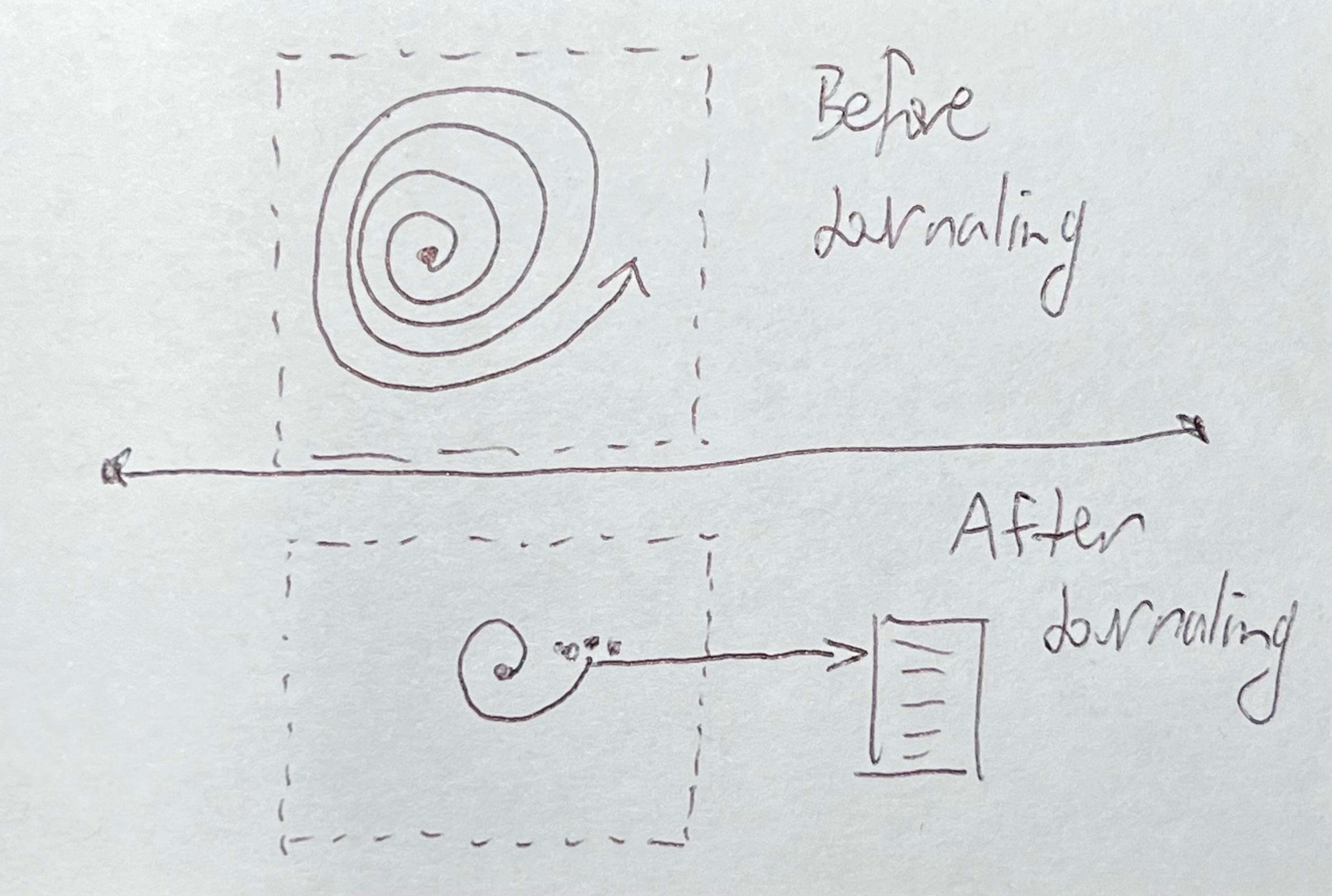
I think of the process as shown in the diagram above. The dotted line represents the boundary of your mind. Without journaling, thoughts can start from a point and spiral out of control. When you have a regular practice of journaling, you have a way to interrupt those repetitive and unproductive thoughts. Putting them down on paper gets them out of your head, both literally and metaphorically.
There is literally an infinite number of ways to do your journaling. I will describe three possible ways here.
Morning Pages
The first approach is the morning pages method invented by the writer and filmmaker Julia Cameron in her book The Artist’s Way.
She describes the technique like this:
Morning Pages are three pages of longhand, stream of consciousness writing, done first thing in the morning. There is no wrong way to do Morning Pages – they are not high art. They are not even “writing.” They are about anything and everything that crosses your mind – and they are for your eyes only. Morning Pages provoke, clarify, comfort, cajole, prioritize and synchronize the day at hand. Do not over-think Morning Pages: just put three pages of anything on the page… and then do three more pages tomorrow.
She has taught the technique at seminars and classes for many years, but practically speaking, there’s not all that much to teach. After all, she just described the essentials in a few sentences.
Users of this technique have reported a lot of good results, including improved productivity, greater alertness, improved moods, reduced worrying, and increased creativity.
Expressive Writing
The second approach is the expressive writing method. It is a form of writing therapy originally developed and studied by psychology professor James Pennebaker and collaborators, starting in the late 1980s.
The original expressive writing study required participants in the experimental group to write about a “past trauma”, expressing deep thoughts and feelings about that experience or memory memory. They would do 15 minutes of continuous writing on this subject every day for four days in a row.
The researchers performed several measurements before and after the four-day writing experiment. The most unexpected finding was that the intervention group made significantly fewer doctor visits after the writing study. Measurements of immune system function in the test subjects also revealed improved immune response in the intervention group.
Many study participants reported being upset by the writing experience. That makes sense. After all, they were writing about some of their most traumatic experiences. Fortunately, they also found it valuable and meaningful.
Daily Diary / Topic Journals
The third approach is daily diary and topic journals method described by Derek Sivers. He recommends keeping these journals in plain text files on your computer and adding to them incrementally.
Daily Diary: “Every day at some point, just open up this diary, write today’s date, then start writing. Write what you did today, and how you are feeling, even if it seems boring.”
Topic Journals: " For each subject that you might have ongoing thoughts about, start a separate ‘Thoughts On’ journal. Whenever you have some thoughts on this subject, open up that file, write today’s date, then start writing."
The daily diary is a pretty fundamental and basic technique, but the topic journals is an approach that I have not seen anywhere else.
He comments on these techniques:
I find it so useful to keep my thoughts on each subject together, because I can see my past thoughts and current thoughts in one place. I can see how my thoughts on this subject have evolved or keep repeating. Sometimes I think I have a new thought on a subject, so I open up the file and write it down, then afterwards I see I had that same thought a year ago and had forgotten about it.
and
Almost all the thoughts I have on any subject are the result of writing in my diary and journals, then questioning myself and working through alternate ways of thinking about it, and finally returning to the subject days or months later with a clear head and updated thoughts, seeing how they’ve changed or not over time.

Photo by Aaron Burden on Unsplash
So What?
Experience shows that no matter what form of journaling you do, you can expect to see some positive results. You can improve your mental health, clarity of thinking, creativity, and perhaps even immune system function.
You don’t need to dedicate too much time to the practice. Studies showed that as little as 15 minutes a day of journaling can deliver measurable and meaningful results.
Originally published on Substack.