The secret to worldly happiness
It is simple but not necessarily easy.
The mental states of craving and aversion both lead to an experience of suffering.
Craving results from a belief that most people hold. This belief is “getting what I want will make me happy."
Aversion is the flip side of this. People also believe: “avoiding what I don’t want will make me happy.”
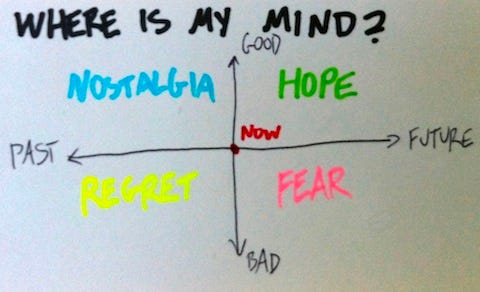
You can find happiness at the intersection of time and equanimity.
What is fear? (aversion to the future)
Fear is a negative story that we tell ourselves about the future. It’s the emotional anticipation that something in the future will be painful.
Telling ourselves this story can sometimes help us. It motivates us to act. When we see a grizzly bear running toward us, our fight-or-flight instinct kicks in. Our distant ancestors who ran from bears lived. The people from the same era who didn’t fear bears died. They also didn’t have kids. That’s why they aren’t our ancestors.
Sometimes ancient traits have value in the modern world. People tend to react with pessimism when large things rush at them. This trait is useful when crossing a street. The Paleolithic world in which our brains evolved never contained cars. Even so, this genetic behavior aligns with personal safety.
Unfortunately, we see a similar reaction in many other areas that are no longer dangerous. We all used to live in little tribes of a couple of hundred people. In that world, social disapproval was a true death sentence. Exile from the tribe increased your risk of death. With no other people around, you also had zero opportunity to reproduce. Exile did not threaten only your survival. It would also take away your chance to be a future ancestor. No wonder primates are social creatures who fear the opinions of others. We fear the opinions of others even when they don’t matter.
Societies and cultures also teach fear. Storytelling is a powerful mechanism for communicating fears from generation to generation. Literature and the entertainment industry have amplified the power of storytelling. Anyone who has seen a couple of horror movies knows the tropes and cliches. When somebody goes to the basement to check out mysterious noises, bad things happen.
Whether genetic, conditioned by society, or a personal feeling, fear is still only a story. It’s a tale we tell ourselves about something going wrong in the future. It’s only a thought. It’s not real.
What is hope? (craving for the future)
Hope is a positive story that we tell ourselves about the future. It is the anticipation that the future is going to be good. Hope is a good thing, right? Who could be against hope?
Hope can be unhealthy when people use it to avoid engaging with the reality of the present moment. When you use hope to escape to a desirable future, you destroy your effectiveness in the present.
In theory, optimism about the future is good. It’s best to ground this optimism in total involvement in your present-moment actions. It does no good to fantasize about a hypothetical future that you’re doing nothing to create. It’s smarter to take action in the present moment. When you direct all your attention to a useful task right now, you’re working to make that good future happen.
As with fear, hope is only a thought. It’s not real. Do your job now. Let go of everything else.
What is regret? (aversion to the past)
All that we (think we) have experienced lies somewhere in our memory. If we hate or reject certain parts of our story, then we split off parts of our persona. We suppress and deny portions of our unconscious minds. This can cause great stress, mysterious psychological difficulties, and misery. This is living in a state of regret, and it’s not pretty.
Being in a state of aversion about some part of our memory is counterproductive. Instead of pushing upsetting memories away, it’s better to make peace with them. You can’t pretend they aren’t there, but you can reinterpret them in a way that removes their power to upset you. As Richard Bandler said, “the best thing about the past is that it’s over.” Because of this, there’s no reason to feel sad in the present about anything that happened in the past.
Most people don’t realize that their memory is not a perfect record of what happened. Forming and storing a memory in your mind is not like writing to computer memory. The human mind deletes, distorts, and generalizes. Every recall of a memory rewrites and changes the memory itself. Your memory is full of stories that change in the telling.
Through prayer, therapy, or coaching, we can change our responses to painful memories. When we do this inner work, the past loses its power to influence our present moment experience. Regret is only a thought. It’s not real.
What is nostalgia? (craving for the past)
In contrast with bad memories, the things we regret, we like to hold on to good memories. We call this the state of nostalgia. We want the memories to stay the same. We love replaying them in our minds, in an attempt to relive the experience over and over.
When the present moment feels painful, our minds like to review happy stories from the past. Although this process can feel good, it takes us out of present-moment awareness. It neuters our ability to function and take action right now. A state of nostalgia makes true present-moment happiness impossible. Craving something from the past is painful.
Full immersion in the present moment is the real key to happiness. Trying to replay the past to avoid the present doesn’t work. It doesn’t make people happy. We find happiness by engaging with reality, not avoiding it.
Nostalgia is only a thought. It’s not real.
So what?
Our well-being and happiness depend on our minds remaining in the present moment.
This is true even when we have happy memories from our past and positive plans for the future. We can’t achieve anything in the present by focusing our attention on times other than now.
Also, in practice, nobody can abide in the good-feeling states of Hope or Nostalgia.
Telling stories about a positive future (hope) can often lead to stories of a negative future (fear). After all, the future is unknown.
Telling stories about the positive past (nostalgia) also activates the negative past (regret). Memories link to each other in mysterious and complex ways. No interval from anyone’s life was ever all good or all bad. It’s all layered and mixed together, like a fractal.
If you are out of alignment with here and now, your mind will oscillate among the quadrants. This doesn’t happen because something is wrong with you as an individual. It is the nature of every human mind.
People who practice prayer and meditation often use the words “centered” or “balanced”. Where and when else is the center or the balance point but here and now?
What does it feel like for you as you revisit the diagram? You may want to pause and think about what this all means. In the end, it may all start to make perfect sense.
What is it like to live in the present moment and accept reality as it is, without judgment? This is how things are when your mind rests at the intersection of the two arrows.
The two axes represent two different ways of being in balance.
The first axis is time. From the center of this axis, you care about neither the future nor the past.
The second axis is your judgment of things. From the center of this axis, you judge no people, things, or circumstances. You are in balance with your stream of experience. You love things as they are and embrace reality without judgment.
Remaining in balance along both of these axes is the key to abiding happiness.
Photo by Karsten Winegeart on Unsplash
Originally published on Substack.